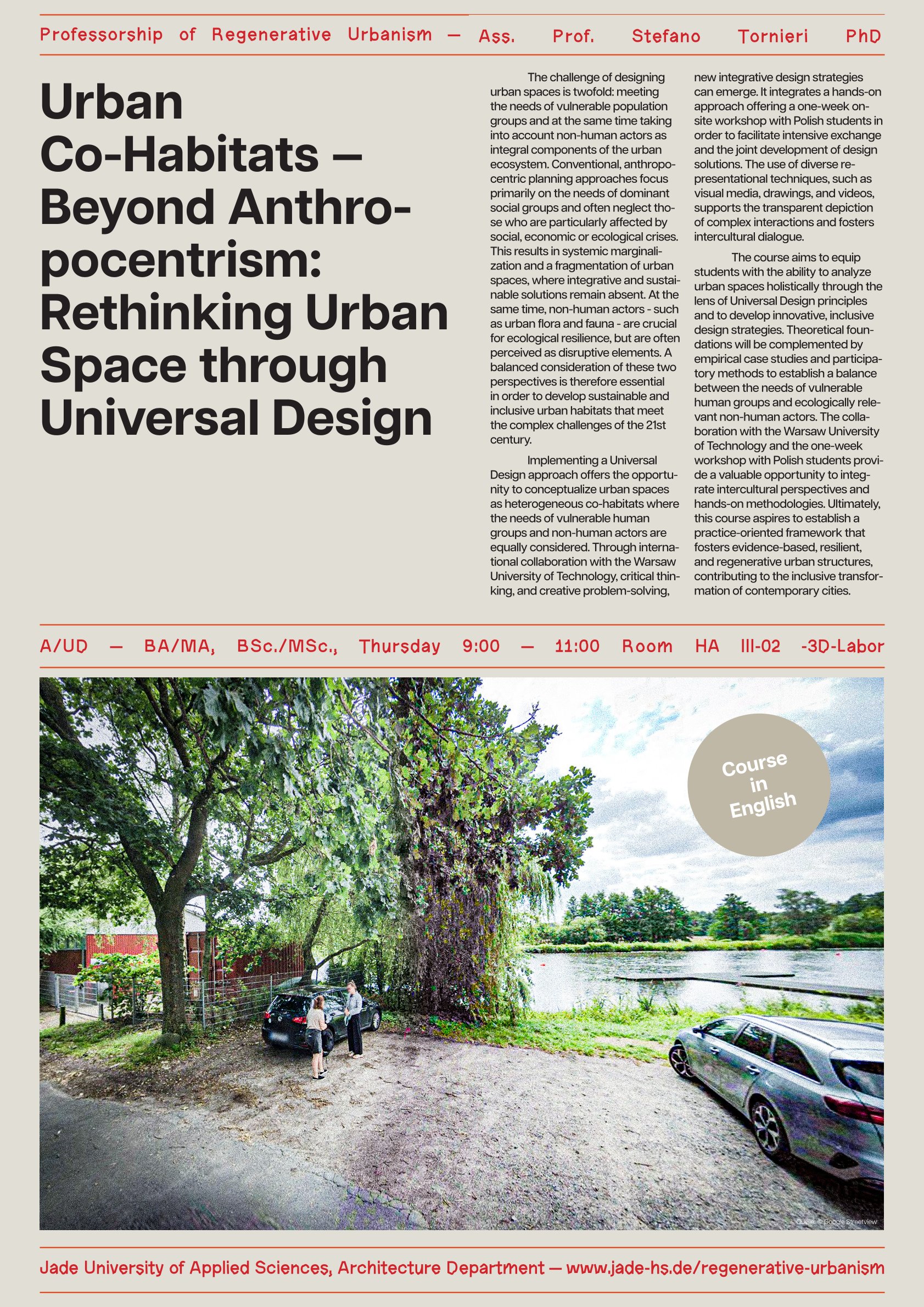
The challenge of designing urban spaces is twofold: meeting the needs of vulnerable population groups and at the same time taking into account non-human actors as integral components of the urban ecosystem. Conventional, anthropo-centric planning approaches focus primarily on the needs of dominant social groups and often neglect those who are particularly affected by social, economic or ecological crises. This results in systemic marginalization and a fragmentation of urban spaces, where integrative and sustainable solutions remain absent. At the same time, non-human actors - such as urban flora and fauna - are crucial for ecological resilience, but are often perceived as disruptive elements. A balanced consideration of these two perspectives is therefore essential in order to develop sustainable and
inclusive urban habitats that meet the complex challenges of the 21st century. Implementing a Universal Design approach offers the opportunity to conceptualize urban spaces as heterogeneous co-habitats where the needs of vulnerable human groups and non-human actors are equally considered. Through international collaboration with the Warsaw University of Technology, critical thinking, and creative problem-solving, new integrative design strategies can emerge. It integrates a hands-on approach offering a one-week on site workshop with Polish students in order to facilitate intensive exchange and the joint development of design solutions. The use of diverse re-presentational techniques, such as visual media, drawings, and videos, supports the transparent depiction of complex interactions and fosters intercultural dialogue. The course aims to equip students with the ability to analyze urban spaces holistically through the lens of Universal Design principles and to develop innovative, inclusive design strategies. Theoretical foundations will be complemented by empirical case studies and participatory methods to establish a balance between the needs of vulnerable human groups and ecologically relevant non-human actors. The collaboration with the Warsaw University of Technology and the one-week workshop with Polish students provide a valuable opportunity to integrate intercultural perspectives and hands-on methodologies. Ultimately, this course aspires to establish a practice-oriented framework that fosters evidence-based, resilient, and regenerative urban structures, contributing to the inclusive transformation of contemporary cities.

© 2026 Regenerative Urbanism. All rights reserved. Imprint Privacy Policy